
C++ Comparison
Java and C++ are similar languages. This topic serves as a quick reference guide for Java and C++ Engineers.
Static Class Members
Section titled “Static Class Members”Static members have class scope as opposed to object scope
// define in headerclass Singleton {   public:      static Singleton *getInstance();
   private:      Singleton() {}      static Singleton *instance;};
// initialize in .cppSingleton* Singleton::instance = 0;public class Singleton { private static Singleton instance;
private Singleton() {}
public static Singleton getInstance() { if(instance == null) { instance = new Singleton(); } return instance; }}Classes Defined within Other Constructs
Section titled “Classes Defined within Other Constructs”Defined within Another Class
Section titled “Defined within Another Class”Nested Class[ref] (needs a reference to enclosing class)
class Outer {   class Inner {      public:         Inner(Outer* o) :outer(o) {}
private: Outer* outer; };};[non-static] Nested Class (aka Inner Class or Member Class)
class OuterClass { ... class InnerClass { ... }}Statically Defined within Another Class
Section titled “Statically Defined within Another Class”Static Nested Class
class Outer { class Inner { ... };};Static Nested Class (aka Static Member Class)[ref]
class OuterClass { ... static class StaticNestedClass { ... }}Defined within a Method
Section titled “Defined within a Method”(e.g. event handling)
Local Class[ref]
void fun() { class Test { /* members of Test class */ };}Local Class[ref]
class Test { void f() { new Thread(new Runnable() { public void run() { doSomethingBackgroundish(); } }).start(); }}Pass-by-value & Pass-by-reference
Section titled “Pass-by-value & Pass-by-reference”Many argue that Java is ONLY pass-by-value, but it’s more nuanced than that. Compare the following C++ and Java examples to see the many flavors of pass-by-value (aka copy) and pass-by-reference (aka alias).
 // passes a COPY of the object  static void passByCopy(PassIt obj) {     obj.i = 22;  // only a "local" change  }
  // passes a pointer  static void passByPointer(PassIt* ptr) {     ptr->i = 33;     ptr = 0; // better to use nullptr instead if '0'  }
  // passes an alias (aka reference)  static void passByAlias(PassIt& ref) {     ref.i = 44;  }
// This is an old-school way of doing it. // Check out std::swap for the best way to do this static void swap(PassIt** pptr1, PassIt** pptr2) { PassIt* tmp = *pptr1; *pptr1 = *pptr2; *pptr2 = tmp; } // passes a copy of the variable // NOTE: in java only primitives are pass-by-copy public static void passByCopy(int copy) { copy = 33; // only a "local" change }
// No such thing as pointers in Java /* public static void passByPointer(PassIt *ptr) { ptr->i = 33; ptr = 0; // better to use nullptr instead if '0' } */
// passes an alias (aka reference) public static void passByAlias(PassIt ref) { ref.i = 44; }
// passes aliases (aka references), // but need to do "manual", potentially expensive copies public static void swap(PassIt ref1, PassIt ref2) { PassIt tmp = new PassIt(ref1); ref1.copy(ref2); ref2.copy(tmp); }Inheritance vs Composition
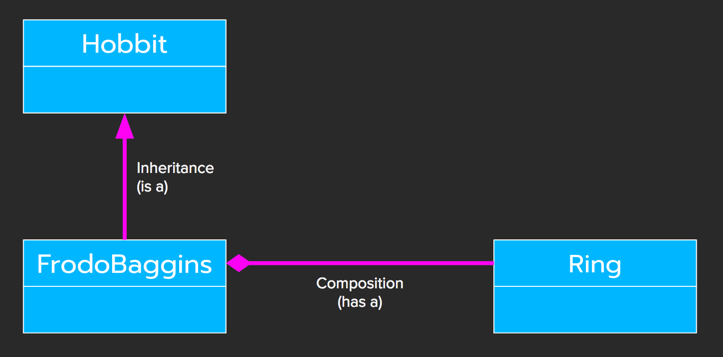
Section titled “Inheritance vs Composition”C++ & Java are both object-oriented languages, thus the following diagram applies to both.
Outcast Downcasting
Section titled “Outcast Downcasting”Beware of using “downcasting” - Downcasting is casting down the inheritance hierarchy from a base class to a subclass (i.e. opposite of polymorphism). In general, use polymorphism & overriding instead of instanceof & downcasting.
C++ Example
Section titled “C++ Example”// explicit type case requiredChild *pChild = (Child *) &parent;Java Example
Section titled “Java Example”if(mySubClass instanceof SubClass) { SubClass mySubClass = (SubClass)someBaseClass; mySubClass.nonInheritedMethod();}Abstract Methods & Classes
Section titled “Abstract Methods & Classes”Abstract Method
Section titled “Abstract Method”declared without an implementation
pure virtual method
virtual void eat(void) = 0;abstract method
abstract void draw();Abstract Class
Section titled “Abstract Class”cannot be instantiated
cannot be instantiated; has at least 1 pure virtual method
class AB {public: virtual void f() = 0;};cannot be instantiated; can have non-abstract methods
abstract class GraphicObject {}Interface
Section titled “Interface”no instance fields
nothing comparable to Java
very similar to abstract class, but 1) supports multiple inheritance; 2) no instance fields
interface TestInterface {}Remarks
Section titled “Remarks”Classes Defined within Other Constructs#
Section titled “Classes Defined within Other Constructs#”Defined within Another Class
Section titled “Defined within Another Class”Nested Class[ref] (needs a reference to enclosing class)
class Outer {   class Inner {      public:         Inner(Outer* o) :outer(o) {}
private: Outer* outer; };};[non-static] Nested Class (aka Inner Class or Member Class)
class OuterClass { ... class InnerClass { ... }}Statically Defined within Another Class
Section titled “Statically Defined within Another Class”Static Nested Class
class Outer { class Inner { ... };};Static Nested Class (aka Static Member Class)[ref]
class OuterClass { ... static class StaticNestedClass { ... }}Defined within a Method
Section titled “Defined within a Method”(e.g. event handling)
Local Class[ref]
void fun() { class Test { /* members of Test class */ };}See also Lambda expressions
Local Class[ref]
class Test { void f() { new Thread(new Runnable() { public void run() { doSomethingBackgroundish(); } }).start(); }}Overriding vs Overloading
Section titled “Overriding vs Overloading”The following Overriding vs Overloading points apply to both C++ and Java:
Polymorphism
Section titled “Polymorphism”Polymorphism is the ability for objects of different classes related by inheritance to respond differently to the same method call. Here’s an example:
- base class Shape with area as an abstract method
- two derived classes, Square and Circle, implement area methods
- Shape reference points to Square and area is invoked
In C++, polymorphism is enabled by virtual methods. In Java, methods are virtual by default.
Order of Construction/Destruction
Section titled “Order of Construction/Destruction”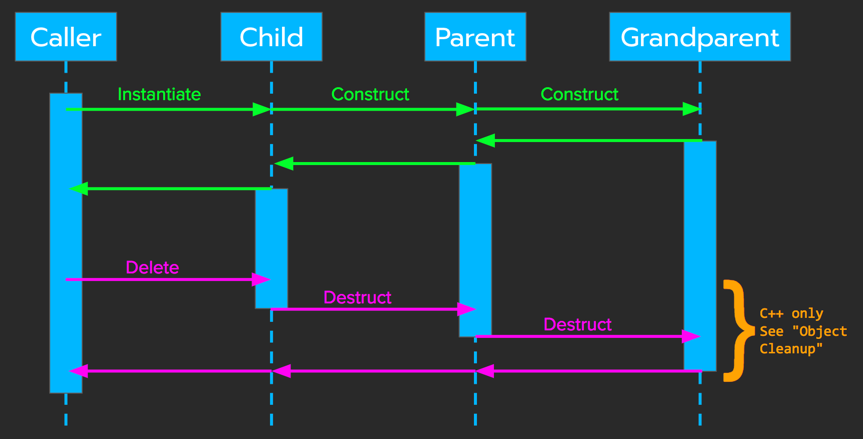
Object Cleanup
Section titled “Object Cleanup”In C++, it’s a good idea to declare a destructor as virtual to ensure that the subclass’ destructor will be called if the base-class pointer is deleted.
In Java, a finalize method is similar a destructor in C++; however, finalizers are unpredictable (they rely on GC). Best practice - use a “close” method to explicitly cleanup.
protected void close() {    try {       // do subclass cleanup    }    finally {       isClosed = true;       super.close();    }}
protected void finalize() {    try {       if(!isClosed) close();    }    finally {       super.finalize();    }}
Abstract Methods & Classes
Section titled “Abstract Methods & Classes”|Concept|C++|Java
|---|---|---|---|---|---|---|---|---|---
|Abstract Method
declared without an implementation|pure virtual methodvirtual void eat(void) = 0;|abstract methodabstract void draw();
|Abstract Class
cannot be instantiated|cannot be instantiated; has at least 1 pure virtual methodclass AB {public: virtual void f() = 0;};|cannot be instantiated; can have non-abstract methodsabstract class GraphicObject {}
|Interface
no instance fields|no “interface” keyword, but can mimic a Java interface with facilities of an abstract class|very similar to abstract class, but 1) supports multiple inheritance; 2) no instance fieldsinterface TestInterface {}
Accessibility Modifiers
Section titled “Accessibility Modifiers”|Modifier|C++|Java |---|---|---|---|---|---|---|---|---|--- |Public - accessible by all|no special notes|no special notes |Protected - accessible by subclasses|also accessible by friends|also accessible within same package |Private - accessible by members|also accessible by friends|no special notes |default|class default is private; struct default is public|accessible by all classes within the same package |other|Friend - a way to grant access to private & protected members without inheritance (see below)|
C++ Friend Example
Section titled “C++ Friend Example”class Node { private: int key; Node *next; // LinkedList::search() can access "key" & "next" friend int LinkedList::search();};The Dreaded Diamond Problem
Section titled “The Dreaded Diamond Problem”The diamond problem is an ambiguity that arises when two classes B and C inherit from A, and class D inherits from both B and C. If there is a method in A that B and C have overridden, and D does not override it, then which version of the method does D inherit: that of B, or that of C? (from [Wikipedia](https://en.wikipedia.org/wiki/Multiple_inheritance))
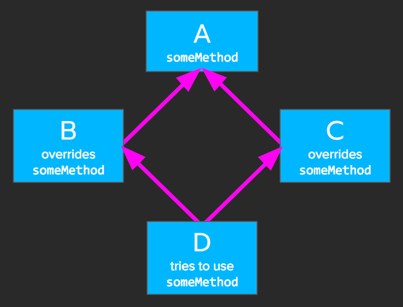
While C++ has always been susceptible to the diamond problem, Java was susceptible until Java 8. Originally, Java didn’t support multiple inheritance, but with the advent of default interface methods, Java classes can not inherit “implementation” from more than one class.
java.lang.Object Class
Section titled “java.lang.Object Class”In Java all classes inherit, either implicitly or explicitly, from the Object class. Any Java reference can be cast to the Object type.
C++ doesn’t have a comparable “Object” class.
Java Collections & C++ Containers
Section titled “Java Collections & C++ Containers”Java Collections are symonymous with C++ Containers.
Java Collections Flowchart
Section titled “Java Collections Flowchart”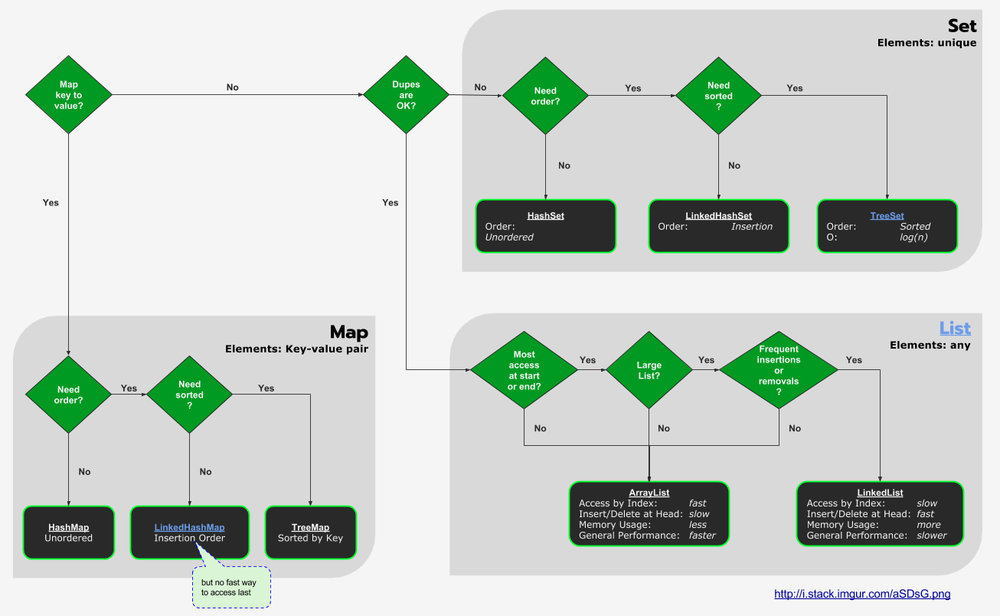
C++ Containers Flowchart
Section titled “C++ Containers Flowchart”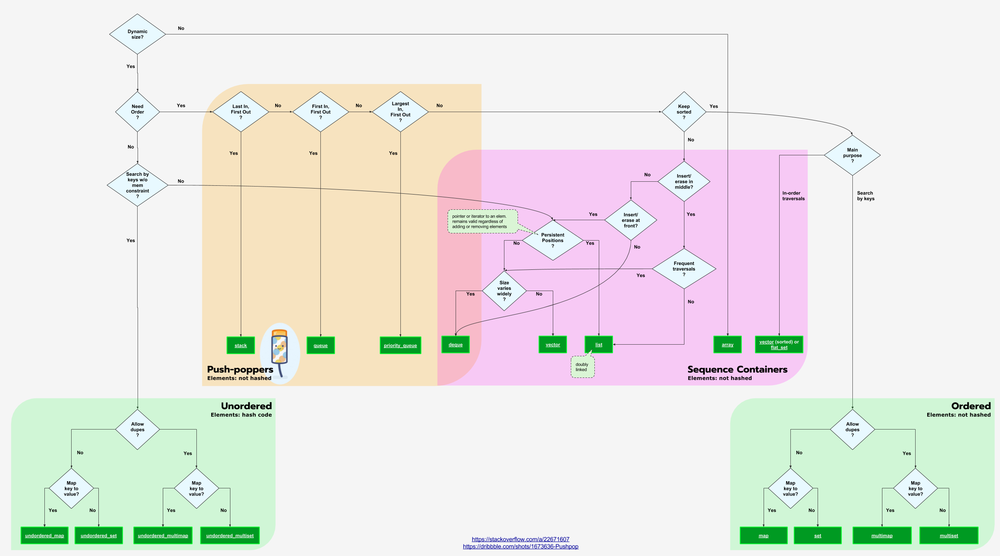
Integer Types
Section titled “Integer Types”|Bits|Min|Max|C++ Type
(on LLP64 or LP64)|Java Type
|---|---|---|---|---|---|---|---|---|---
|8|-2(8-1) = -128|2(8-1)-1 = 127|char|byte
|8|0|2(8)-1 = 255|unsigned char|—
|16|-2(16-1) = -32,768|2(16-1)-1 = 32,767|short|short
|16|0 (\u0000)|2(16)-1 = 65,535 (\uFFFF)|unsigned short|char (unsigned)
|32|-2(32-1) = -2.147 billion|2(32-1)-1 = 2.147 billion|int|int
|32|0|2(32)-1 = 4.295 billion|unsigned int|—
|64|-2(64-1)|2(16-1)-1|long*|long long
|64|0|2(16)-1|unsigned long*
unsigned long long|—
* Win64 API is only 32 bit